
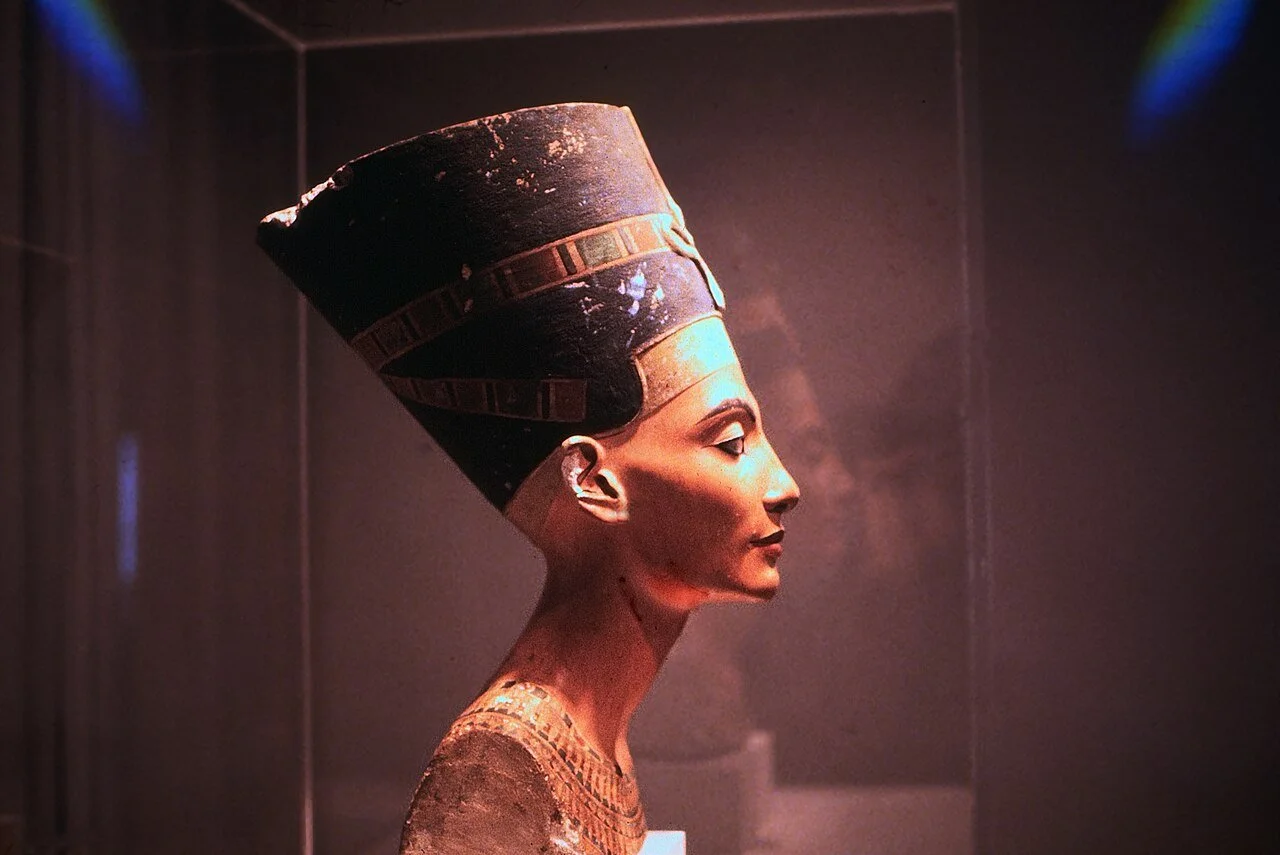
Nefertiti Bust, ca. 1351–1334 BC
Berlin, Staatliche Museen zu Berlin, Ägyptisches Museum und Papyrussammlung, Neues Museum, ÄM 21300
Image here: Rüdiger Stehn from Kiel, Deutschland, CC BY-SA 2.0 <https://creativecommons.org/licenses/by-sa/2.0>, via Wikimedia Commons, at https://commons.wikimedia.org/wiki/File:07_Berlin-Klassenfahrt_1979-_Nofretete-B%C3%BCste,_%C3%84gyptisches_Museum_(17461602724).jpg
Hers has long been a name with which to conjure. Ever since the discovery of the bust of Nefertiti by German archaeologists in 1912, this queen of Egypt has fascinated and beguiled. But who was she? And why were the archaeologists digging at the remote and desolate site of Amarna in the first place? The answer comes by way of her husband, Pharaoh Akhenaten – the heretic pharaoh.
Originally known as Amenhotep IV, in the fifth year of his reign (ca 1358BC) he announced the greatest change to Egyptian customs in millennia. No longer would the chief Egyptian god be Amun (diligently venerated by the powerful priesthood of Thebes), but the Aten – the visible disc of the sun.
Everything was now to change. A new capital was to be founded: Akhetaten, or The Horizon of the Aten. The pharaoh would also have a new name: Akhenaten: Living Spirit of the Aten. The old gods and customs would be abandoned.
The heresy didn’t last long, but the new capital was built. And it is from here that we have been able to piece together at least some of this remarkable pharaoh’s reign. After he died, the old order was restored, and the new regime did its best to obliterate all record of him. But in abandoned Akhetaten - now known as Amarna - and elsewhere, archaeologists have uncovered a treasure trove of beautiful contradictions. Most startling of all is the artistic aesthetic of this period. The depictions of Akhenaten’s queen, Nefertiti, represent a pinnacle of perfection, whose power is still felt today. Stranger though are the depictions of Akhenaten himself. Why was this man depicted with a woman’s hips and pregnant? What is the explanation of his beguiling, elongated features?
Let’s dig deeper and discover more about the heretic pharaoh and his beautiful queen.
RJW F2631 Online (via Zoom)
A 5-hour short course, delivered via 2 x 2½-hour sessions on consecutive Saturdays (Saturday 3 & Saturday 10 October).
£40 (individual registration); £72 (for two people sharing one screen).