
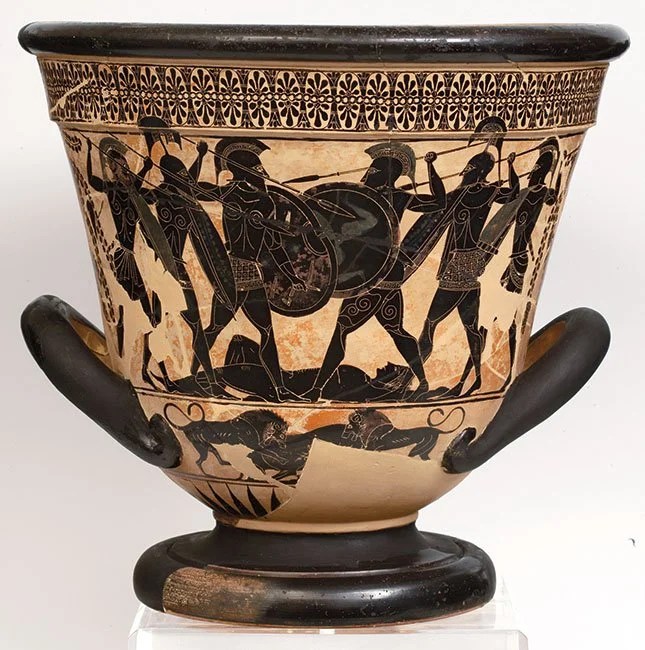
Greeks doing battle, ca 530 BC
Attic black-figure calyx krater, from Pharsala, Thessaly. In the manner of Exekias
Athens, National Archaeological Museum, A 26746
This image, via: https://www.namuseum.gr/en/collection/archaiki-periodos-2/
‘The growth of the power of Athens and the alarm which this inspired in Sparta made war inevitable.’
So said Thucydides, the ancient Greek historian, who painstakingly narrated and dissected the events of the Peloponnesian War. That war ultimately ruined its two great protagonists. Athens, the loser, suffered the quickest and most obviously, but Sparta would also never be the same again.
Soon after, the very notion of the fully independent Greek city-state would find itself on short notice, as first the Macedonians and then, with even greater totality, the Romans, dominated the country. But the ancient writers recognized that Athens and Sparta had each achieved something remarkable: an enduring legacy.
The Athenians proudly recognized it in themselves in real time. See, for example, Pericles’ Funeral Oration – arguably the most famous speech of the Ancient World: ‘Future ages will wonder at us, as the present age wonders at us now’. Powerful stuff!
No contemporary Spartan would have embarrassed himself or his people with comparable boasts of Sparta’s glory. But the writers of the age that followed did the job for them. If anything, they carried the torch for Sparta even more than for Athens. Plutarch recorded no fewer than seventy-six anecdotes about Sparta. My two favourites will serve to illustrate his admiration. ‘When the Thebans invaded Sparta and stopped at the River Eurotes, they all asked “Where are the Spartans now?”. “Not here”, said a Spartan captive, “Or you wouldn’t have got this far”’.
Similarly, we’re told that a Spartan boy, being asked what he knew, said ‘how to be free’.
Effete, brilliant, and proud Athenians; grim, brutal, but utterly cool Spartans (and the later Ancient World certainly found them totally cool!). We’ve got to get to know and understand them better.
RJW F2638 Online (via Zoom)
A 5-hour short course, delivered via 2 x 2½-hour sessions on consecutive Saturdays (Saturday 5 & Saturday 12 December).
£40 (individual registration); £72 (for two people sharing one screen).