
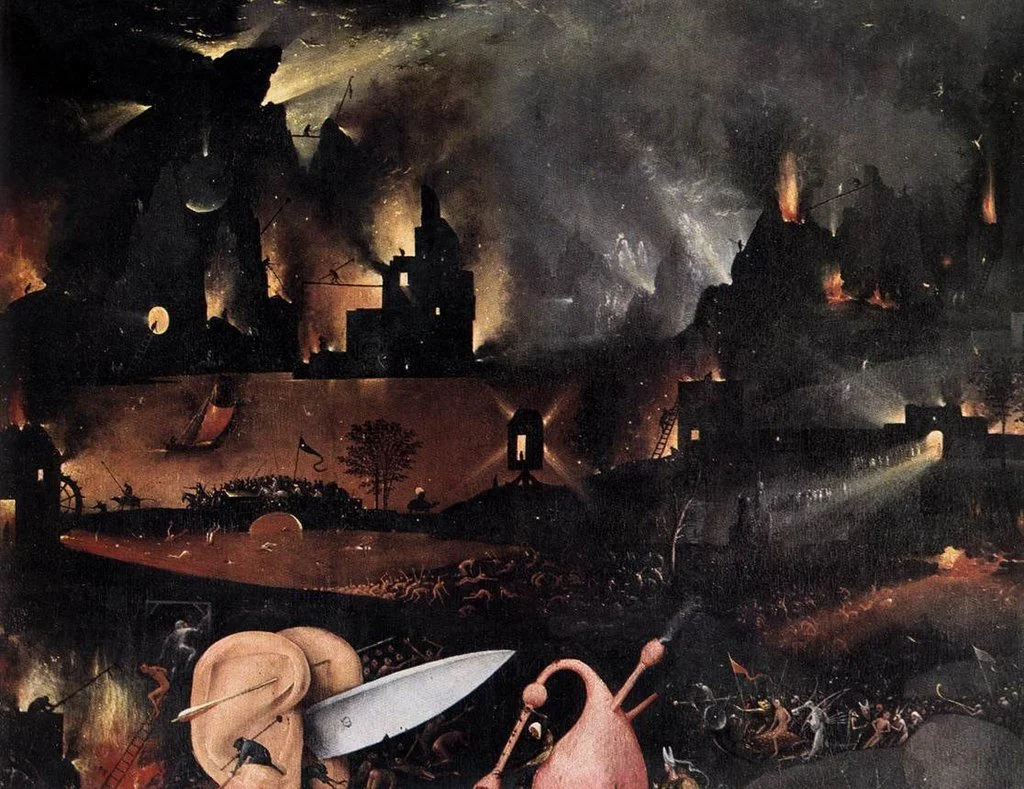
Hieronymus Bosch, Triptych of Garden of Earthly Delights (detail), 1490 x 1500
Madrid, Museo Nacional del Prado, P002823
Image here via: https://commons.wikimedia.org/wiki/File:Hieronymus_Bosch_-_Triptych_of_Garden_of_Earthly_Delights_(detail)_-_WGA2526.jpg
Hieronymous Bosch, also known as Jerome van Aken, lived an entirely conventional life. This Dutch artist ruffled no feathers, and excited no controversies. And yet his artworks – only about thirty of which have been identified with certainty – have become world-famous for their apparent surrealism, mysticism, and nightmarish visions.
The interest in Bosch began early. Philip II of Spain, a monarch so deeply Catholic that he rejected El Greco, nonetheless avidly collected the works of this earlier artist. And yes – that’s why so many of Bosch’s paintings are in the Prado today!
So what was it about him? Was he really a Surrealist before his time? Probably not, a glance at the works of other Netherlandish artists (Breughel and others) tell us that much of we may consider surreal was in fact a way of depicting well-known folkloric symbols and tropes.
And yet… and yet… Bosch’s creative imagination ran further than any of his contemporaries, and (possibly) successors. We’ve got to find out more, so let’s step into the Garden of Earthly Delights!
RJW F2608 Online (via Zoom)
A 5-hour short course, delivered via 2 x 2½-hour sessions on consecutive Mondays (Monday 23 February & Monday 2 March).
£40 (individual registration); £72 (for two people sharing one screen).