
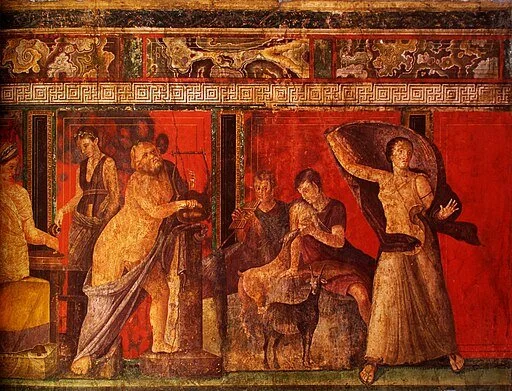
Fresco, ca 70-60 BC
Pompeii, Villa dei Misteri, Room 5
This image: https://en.wikipedia.org/wiki/Villa_of_the_Mysteries#/media/File:Fresque_des_myt%C3%A8res,_Pomp%C3%A9i.jpgg
The Romans loved to assimilate foreign religions. Wherever they went, a venerable Roman deity was clearly the twin of any local god or goddess – vide, for example: Sulis-Minerva in modern-day Bath.
And yet some religions elicited a hostile reaction from the Roman state. Even back in the days of the Republic, the Senate took a dim view of the fact that the priests of Kybele castrated themselves, and tried to stop the cult from spreading. But they were on a hiding to nothing. Mystery religions from Greece and the East would soon dominate the inner religious life of many a Roman. We will explore the oldest cults of Rome, whose gods and goddesses often had very local origins, and see how they were gradually blended with the Greek pantheon, together with all its myths and legends. We will then move on to those cults whose origins were in Egypt and Asia: Isis, Serapis, and Kybele.
As the Empire expanded, so did Roman religion, eventually incorporating Celtic and even Persian deities, whose cults were often very popular with the troops and moved with them as they were posted all over the Roman Empire.
We will also pay close attention to the religion of the home – so fundamental to the Romans: the lares and the penates, as well as the spirits of family and place. All in all, it will be a dizzying and fascinating tour.
RJW F2605 Online course (via Zoom)
7 weeks, Monday 2 February - Monday 23 March (incl., with a mid-course break on 2 March).
£80 (individual registration); £144 (for two people sharing one screen).