
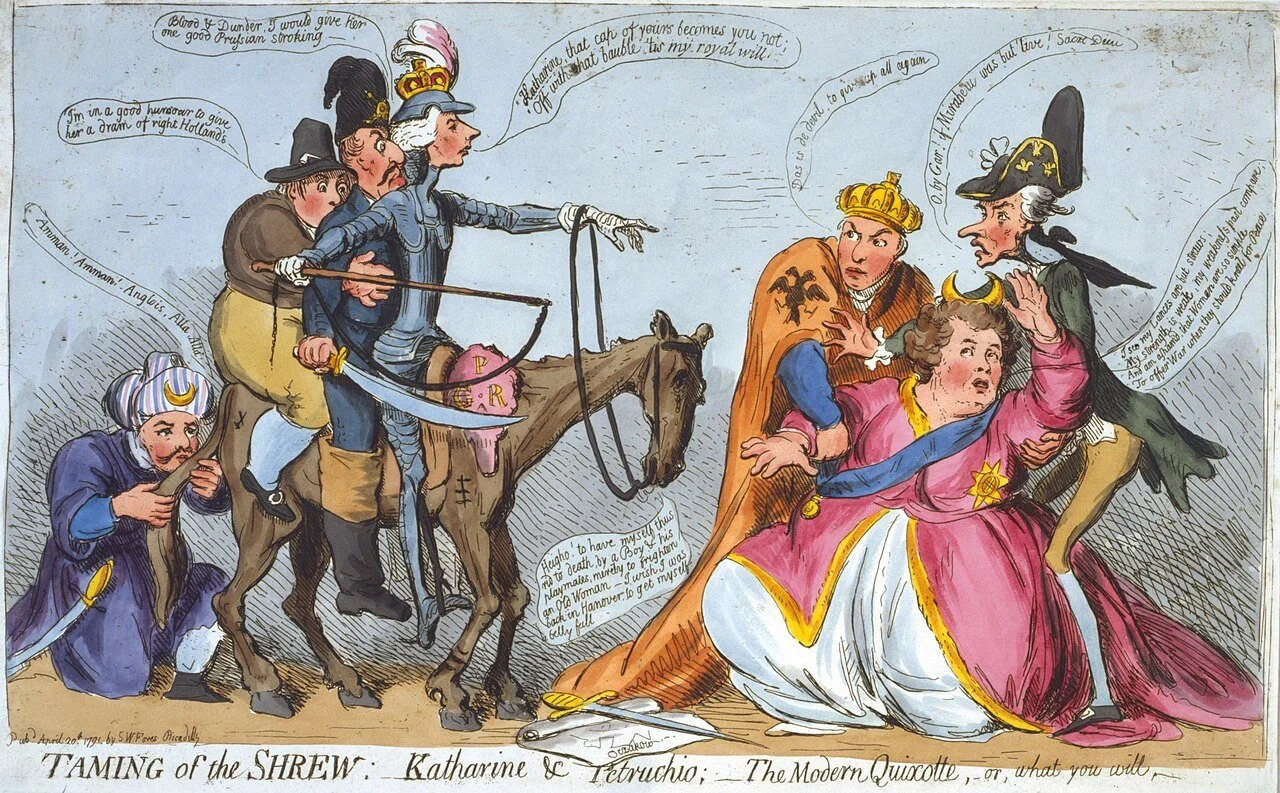
James Gillray, Taming of the shrew: —Katharine & Petruchio; —The modern Quixotte, —or, what you will, 20 April, 1791
Image here via: https://en.wikipedia.org/wiki/File:Taming-of-the-Shrew-Gillray.jpeg
“The star of the north” – that was the name Voltaire gave to Catherine the Great. He knew the empress loved flattery, and so laid it on with a trowel. Most of his enlightened friends adored her too, but agreed that it was best not to enquire too deeply into the matter of her late husband.
That would be Peter III (or the Drunkard from Holstein, as she liked to call him). He had been murdered by a group of Russian nobles – at least one of whom was Catherine’s lover. Her complicity was suspected by everyone, and yet she was soon confirmed as Empress of Russia in her own right. And what a reign it would be. Russia became an expansionist power, every bit the equal of the oldest states in Europe, and its Empress the very model of the enlightened despot.
It would be natural to assume that she must have been a descendant of that earlier “Great” – the first Peter – but nothing could be further from the truth. In fact Catherine wasn’t even Russian, or originally called Catherine! She had married Peter the Great’s grandson at the age of 17 – and it was then that her name was changed, from her native Sophie of Anhalt-Zerbst. Her husband had been raised in German-speaking Holstein, and her own small state was part of a sphere of influence being carefully constructed by the Russian empress Elizabeth and her ministers.
That was how she came to marry the heir to the Russian throne. His aunt Elizabeth brought the pair to Russia and installed them in their own palace as the young rulers-to-be. And they absolutely hated one another. Join us to discover what happened next and how this unlikely ruler became The Great.
RJW F2612 Online (via Zoom)
A 5-hour short course, delivered via 2 x 2½-hour sessions on consecutive Mondays (Monday 20 April & Monday 27 April).
£40 (individual registration); £72 (for two people sharing one screen).