
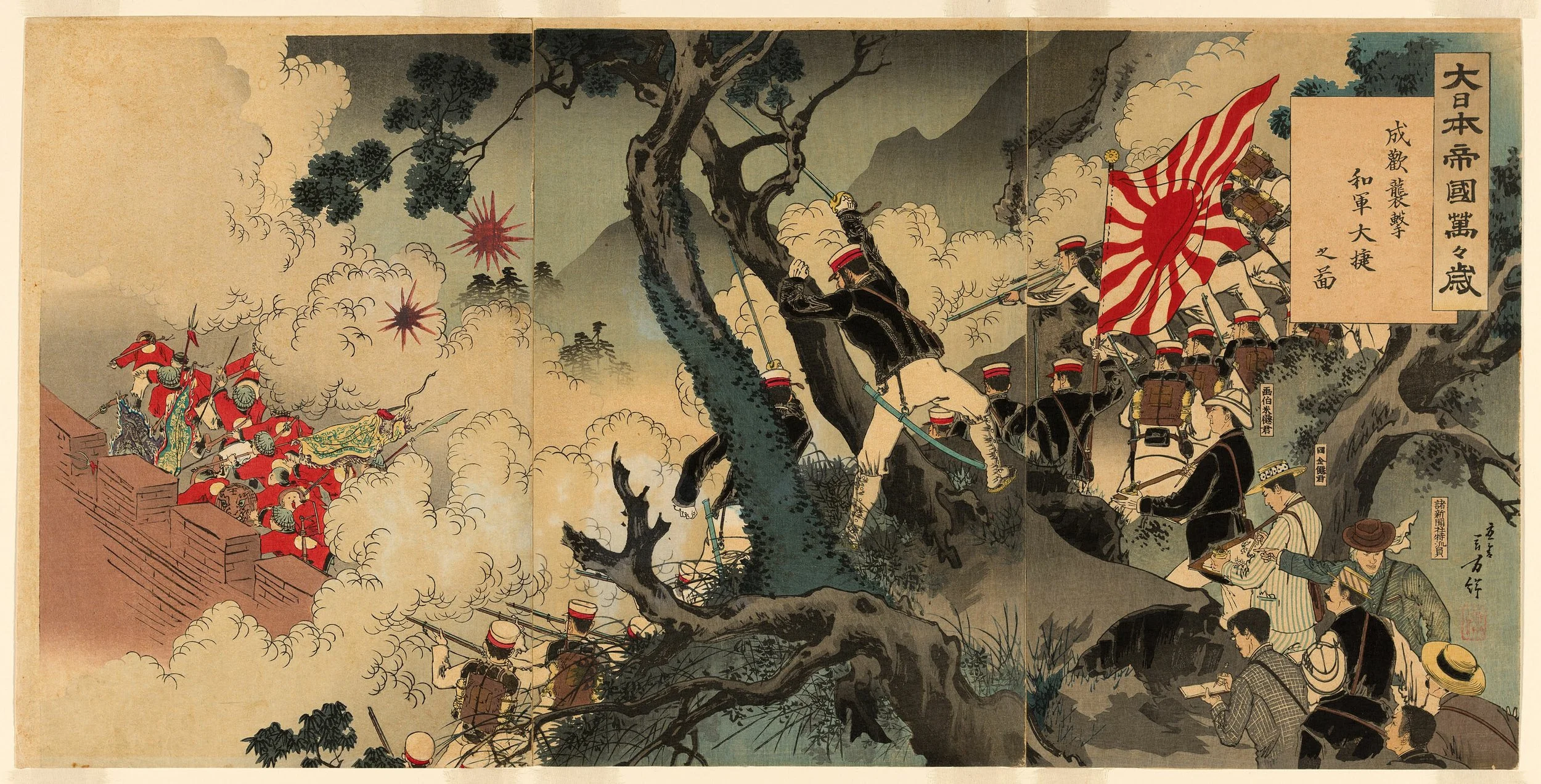
Mizuno Toshikata, Long Live the Great Japanese Empire! A Great Victory for Our Troops in the Assault on Songhwan (Dai Nihon teikoku banbanzai, Seikan shugeki waga gun taisho no zu), 1894
This image: Chicago, Art Institute of Chicago, Mr. and Mrs. Hubert Fischer Fund, 1995.206.16
https://www.artic.edu/artworks/223519/long-live-the-great-japanese-empire-a-great-victory-for-our-troops-in-the-assault-on-songhwan-dai-nihon-teikoku-banbanzai-seikan-shugeki-waga-gun-taisho-no-zu
Try as we might, we Westerners can’t imagine Japan without its art. Recent exhibitions on the Samurai as well as the Ukiyo-e prints have had rave reviews, and the Japanese aesthetic is more popular than ever. It can be seen in everything from the comic book to the sushi restaurant.
But where and when did all this begin? How did those few small islands come to have such powerful influence – economic, political, and cultural? To answer that, we shall take a journey through Japanese history and culture from the Iron Age to the Age of Empires. Along the way, we’ll meet the Samurai and see how their swords were (and are) made; we’ll wander through the Floating World of Edo, before picking up a manga from a bookseller (who knows? It may even be by Hokusai!), and then go on to watch a Kabuki show or a sumo bout.
But this is a historical journey too. We’ll meet the Shoguns and try to understand their military government, marvelling at the great castles and fortresses of feudal Japan, which saw off two attempted Mongol invasions. At the end will come the fateful encounters with the imperialist West and the crisis which saw the end of the Tokagawa Shogunate and the Meiji Restoration.
Japan’s political trajectory soon made conflict with the expansionist powers of the northern hemisphere inevitable. We shall study in particular the first of those: the Russo-Japanese War of 1904-5, before considering also the gathering storm which led to tragedy just forty years later. Throughout, our historical understanding will be via the artists, the scholars, and the poets who paint our journey.
RJW F2613 Online course (via Zoom)
7 weeks, Tuesday 21 April - Tuesday 9 June (incl., with a half-term break on 26 May).
£80 (individual registration); £144 (for two people sharing one screen).