
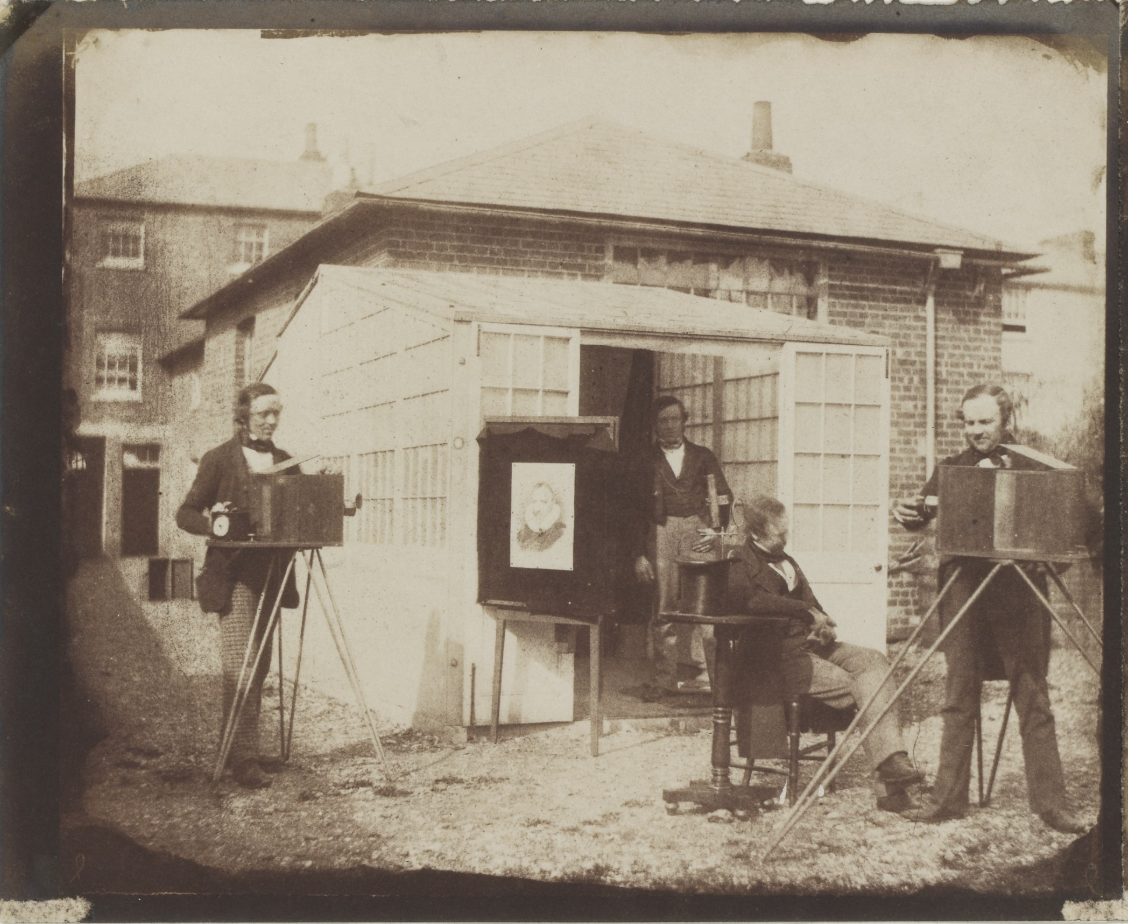
William Henry Fox Talbot, The Reading Establishment, 1846
New York, Met Museum, Gilman Collection, Gift of The Howard Gilman Foundation, 2005, 2005.100.171.1, .2
This image: https://www.metmuseum.org/art/collection/search/283065
The quest to fix a photographic image onto a light-sensitive surface had been ongoing since at least the early eighteenth century. In 1717 the German Johann Heinrich Schulze discovered that a slurry of chalk and nitric acid into which silver particles had been dissolved was darkened by sunlight, but he could find no way of adapting his discovery to create a permanent image. Later in England, Thomas Wedgwood and Humphrey Davy produced photograms by a similar process, but again failed to find a way of fixing the image.
It would not be until 1826 that the breakthrough was made. Frenchman Joseph Nicéphore Niépce finally managed to fix an image created by a camera. The process was, however, less than satisfactory. The image was faint and crude, and it took several days of exposure to develop. By 1839, Niépce’s associate Louis Daguerre had found a way to make images both quicker and financially viable. Photography was born!
Competition was soon afoot - most notably from Englishman William Henry Fox Talbot, who had developed his own very different process. By the mid nineteenth century, the photographic revolution was in full swing.
We will celebrate the early history of photography, and explore the work of some of its pioneers. In addition to Daguerre and Fox Talbot, we shall meet Hippolyte Bayard, Julia Margaret Cameron, Roger Fenton (the first war photographer), and Nadar, arguably photography’s first celebrity.
RJW F2614 Online course (via Zoom)
5 weeks, Wednesday 22 April - Wednesday 20 May.
£65 (individual registration); £117 (for two people sharing one screen).