
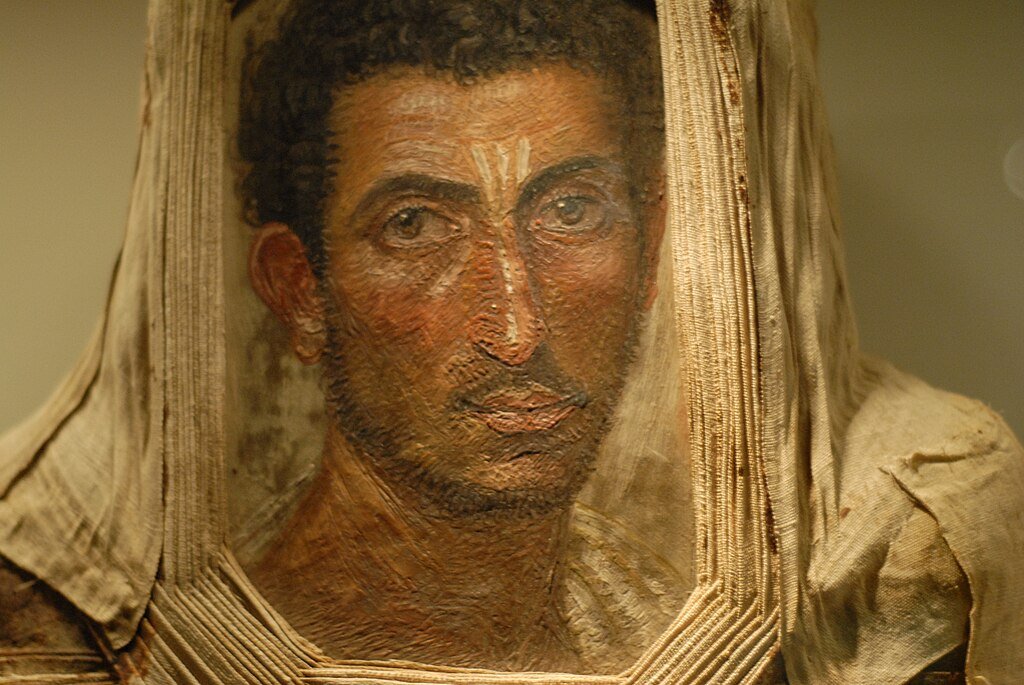
Mummy portrait, Fayum
Edinburgh, Royal Museum of Scotland, 1911.210.1
This image: https://commons.wikimedia.org/wiki/File:Hawara_MoS_1911.210.1.JPG
The last flowering of pharaonic power under native Egyptian rulers came to an end in 525BC with the fall of the twenty-sixth dynasty and the Persian invasion. After that, Egypt was mostly ruled by foreigners: Persians, Libyans, and Assyrians, with brief native revivals. The title of Pharaoh was still used by the conquerors though, and so thirty-one dynasties can be counted all the way from the very first, which began its rule over Egypt in 3100BC.
That all ended for good when Alexander the Great conquered Egypt in 332BC. Though he spent little time there - soon rushing off to conquer the Persian Empire and dying in Babylon in 323BC - he did order a city to be built bearing his name. Alexandria by Egypt would become perhaps the greatest city of the Hellenistic Age. It would also be the capital of Egypt and the seat of the Ptolemies for over three centuries. These rulers were descendants of one of Alexander’s generals. Installed as Egypt’s governor, the first Ptolemy held on fast to this richest of lands and made himself king soon after his leader’s death. He even kidnapped Alexander’s body and brought it to his capital!
This would be the beginning of a new golden age for Egypt. Along the Nile and throughout the Delta as well as around the great Faiyum Oasis, great cities rose and flourished, and Egyptian culture merged with that of settlers from all over the Hellenistic world. Some of these cities have been rediscovered in recent years – most notably Thonis-Heracleion and Canopus – giving archaeologists a window into their rich and cosmopolitan way of life.
And Egypt was rich. Even under the incompetent and decrepit rule of the later Ptolemies. When it became a province of Rome in 30BC, its wealth astounded the new rulers. The Emperor Augustus made sure that its governorship was always an imperial appointment, and a close eye was kept upon those granted power there. Egypt had a tendency to give men delusions of grandeur.
We will follow the history of this land from the rise of the Ptolemies to the Islamic invasion nearly 1,000 years later, and marvel at its material culture.
RJW F2618 Online course (via Zoom)
5 weeks, Wednesday 3 June - Wednesday 1 July.
£65 (individual registration); £117 (for two people sharing one screen).