
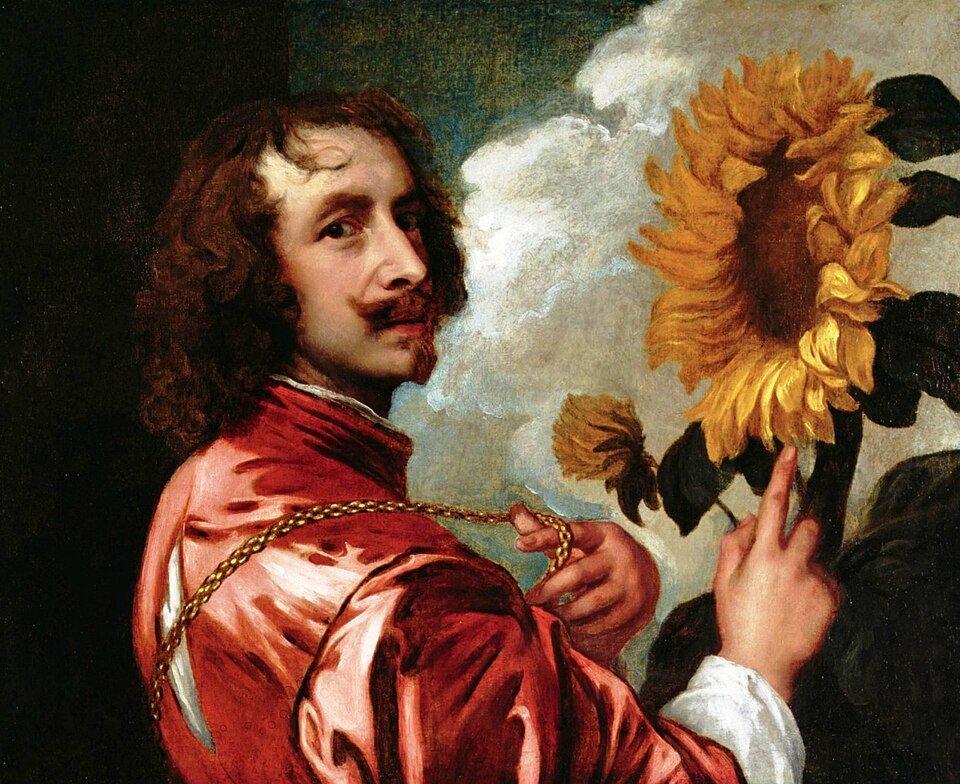
Anthony van Dyck, Self-portrait with a Sunflower, after 1633
Eaton Hall, Cheshire, Duke of Westminster’s Collection
This image via: https://commons.wikimedia.org/wiki/File:Anthony_van_Dyck_-_Self-portrait_with_a_Sunflower.jpg
“Slappable”. That’s how one of my early students (a retired art teacher, I should note) summed up Rubens’ work. I suppose it’s not entirely unfair. This Flemish artist took the Baroque to ever greater, more visceral, and more carnal heights! He was a fascinating man. An early collaborator with Jan Brueghel the Elder, his work soon dominated his home city of Antwerp, and led him to both fortune and celebrity.
His younger assistant, Anthony van Dyck, was no mere follower. His sophisticated refinement of Rubens’ style would have a profound impact on the hitherto rather philistine English in particular. So much so, that on his deathbed, Gainsborough declared, ‘We’re all going to heaven, and van Dyck is of the company!’.
Let us discover why both these men were so loved, admired, and influential in their own times and beyond.
RJW F2636 Online (via Zoom)
A 5-hour short course, delivered via 2 x 2½-hour sessions on consecutive Mondays (Monday 16 & Monday 23 November).
£40 (individual registration); £72 (for two people sharing one screen).