
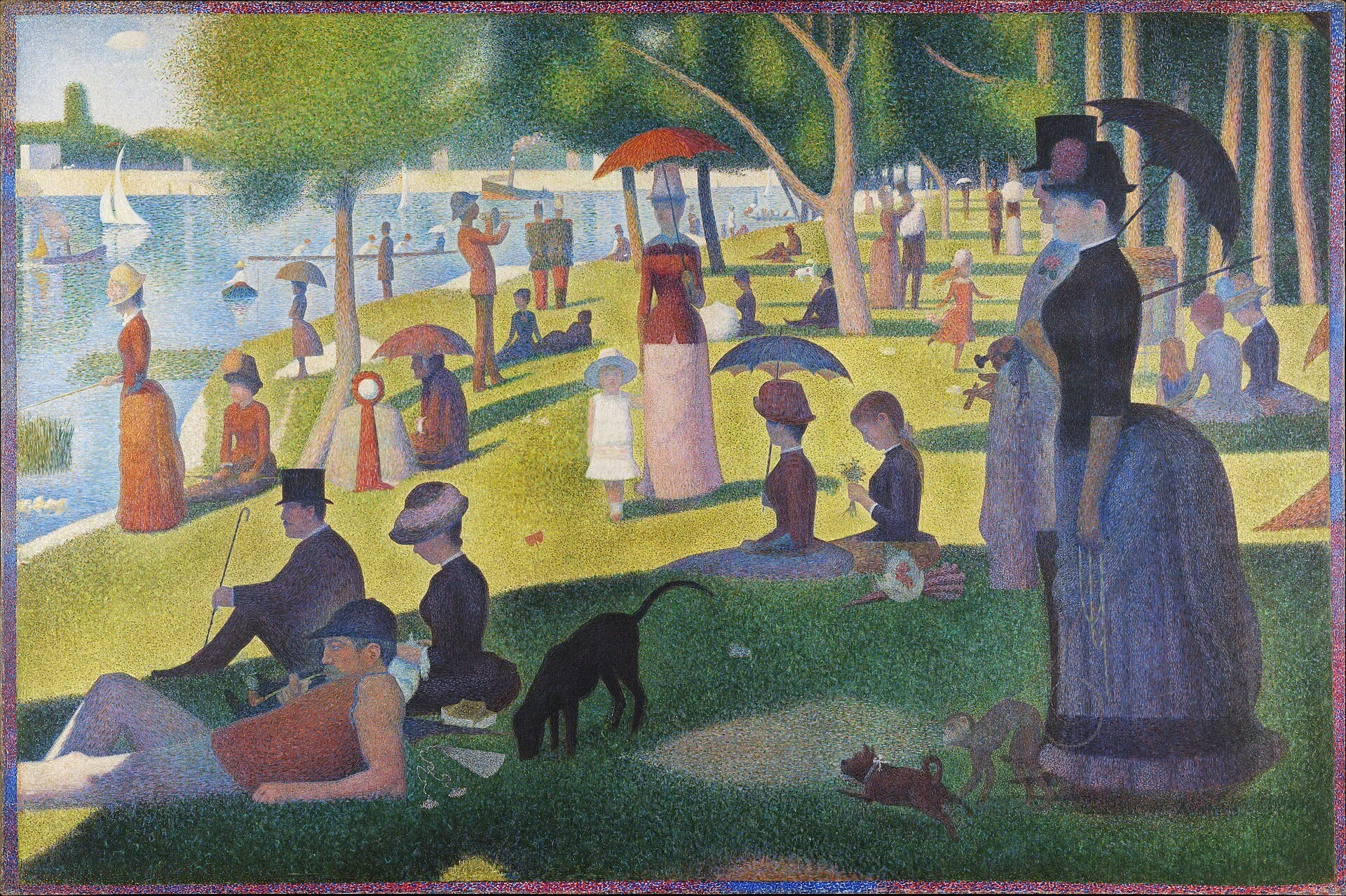
Georges Seurat, A Sunday on La Grande Jatte, 1884-86
Chicago, IL, Art Institute of Chicago, Helen Birch Bartlett Memorial Collection, 1926.224
Image here via Wikimedia at https://commons.wikimedia.org/w/index.php?curid=11500785
By the 1880s, the French public had become familiar with the term ‘Impressionist’. It had first been coined by a journalist in 1874, in a review of an exhibition which included works by key members of the group who would eventually be known by that name. Though few of the original Impressionists much liked the term, they did recognize that it had taken on a broad meaning with both the press and the public at large.
In short, an Impressionist painting was likely to be bright, vividly coloured, loosely/spontaneously executed, and to deal exclusively with observable reality.
By the mid-1880s some people openly confessed to liking these works. Claude Monet and his friends had begun to make some money. There were even those who accorded them great respect as the pioneers of a new way of seeing; one which allowed the observation of light and colour - and nothing else - to determine what a painting would look like. The genius of Giverny in particular had always stuck hard and fast to this rule of only painting colour, uninfluenced by what his brain knew an object or scene to be. By 1886 he was very good at it. Surely there was no further progress to be made in modern painting!
Enter: The young, impeccably trained, and breathtakingly talented Georges Seurat, accompanied by his even younger friend, Paul Signac. They’d been hanging round the fringes of the Impressionist movement for a few years now, but had not exhibited with them. In 1886, though, at the behest of Camille Pissarro, who had already begun to experiment with their way of working, they submitted paintings to what would turn out to be the final Impressionist exhibition.
Other than Pissarro, the remainder of the Impressionists were far from impressed. The quest to understand how the eye received and interpreted light and colour had surely been taken too far by these young men, who seemed to have forgotten that they were artists rather than scientists. It was even quipped that Seurat painted in a lab coat! Their work was placed in the back room of the exhibition space. As controversy was anticipated, the other painters insisted that the public should at least see their own work first.
The entire back wall was taken up by Seurat’s A Sunday on La Grande Jatte – a vast work executed with forensic precision and, it seemed, a zealot’s (or lunatic’s) commitment to a principle. It consisted of millions of tiny dots of pigment juxtaposed according to scientific theories concerning the effects of complementary colours. New Impressionism was revealed to the world, whether the world was yet ready for it or not.
Seurat would continue to develop this new method for the rest of his tragically short career, but it was Signac who turned it into a movement. We will explore the work of both artists, as well as those who later joined them.
RJW F2624 Online (via Zoom)
A 5-hour short course, delivered via 2 x 2½-hour sessions on consecutive Mondays (Monday 20 & Monday 27 July).
£40 (individual registration); £72 (for two people sharing one screen).