
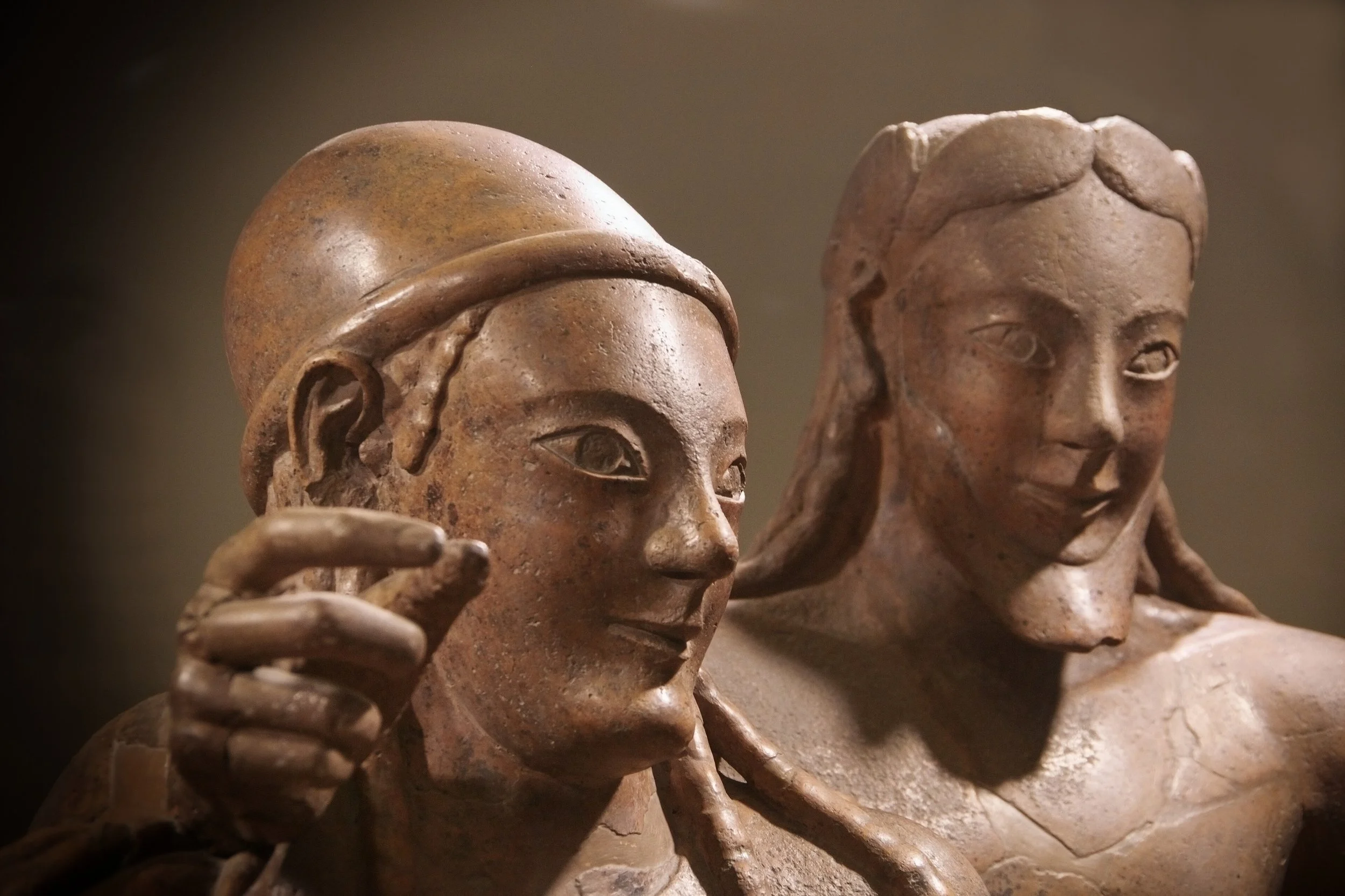
Sarcofago degli Sposi, 530-520 BC
Rome, National Etruscan Museum, 6646
Image here: Giuseppe Savo - Own work, CC BY-SA 4.0, via https://commons.wikimedia.org/w/index.php?curid=62180537
Who were the Etruscans? These inhabitants of the modern region of Tuscany certainly had an impact on their contemporaries. The Greeks knew them as expert metal workers and traded with them extensively, recognizing also that they were quite distinct from their Italian neighbours. Their dozen or so city-states boasted not only sophisticated roads and drainage, but also elegant temples and sublime art. Some Greek writers suggested that they had migrated into Italy from lands in the East, though there was no consensus as to exactly where that might have been.
Their Latin neighbours to the south also knew them well – not just as trading partners, but for a time at least as colonizing overlords. And one of those Latin city-states was Rome. Some of its early kings bore Etruscan names, and several of its early developments – round-headed archways, the draining of the Forum, as well as the practice of augury – quite possibly had Etruscan origins.
But what of the Etruscans themselves? This is where a certain of air of mystery descends. Despite having adapted a written alphabet via the Greeks, we can only read a very few Etruscan words. Their language is largely undeciphered, and just like them, of an uncertain origin. We do know that they called themselves Rasenna. What they have left us is a spectacular funerary culture – entire cities of the dead with lavishly decorated tombs, vivid wall paintings, life-like terracotta sculptures, and the very finest imported Greek objects.
They appear to have loved life, lived it to the full, and, furthermore, accorded women a far more visible place within society than any of their contemporaries. Join us to explore the fascinating - and yet tantalizingly elusive - world of the Etruscans.
RJW F2625 Online (via Zoom)
A 5-hour short course, delivered via 2 x 2½-hour sessions on consecutive Saturdays (Saturday 1 & Saturday 8 August).
£40 (individual registration); £72 (for two people sharing one screen).